


Games for Learning: Small Browser Games That Teach How Shared Resources Work
In a game, you make the mistake yourself and you see what it costs. That teaches more than a chart.
I build small games that run in a web browser, with nothing to install. Two of them teach how an environmental resource behaves: groundwater and a fire-adapted forest. The third is a building game that I made to test game parts inside a normal web page. AI tools let one person build and test a game like this in days, so a small organization can afford one.
Each game is small on purpose. You learn the rules in a minute and finish a full run in one sitting. Then you play again, because now you have a theory about what went wrong.
Why play belongs in app design
People explore an app when it gives them wonder and discovery. That feeling comes from the structure of a game:
- A goal that you care about.
- A choice that has a cost.
- Feedback that you can see right away.
- A reason to try again.
A report can tell you that the water table fell six meters. A game lets you deepen the farm well yourself, and then watch the family well next door go dry.
Who these games are for
- Teachers and outreach teams who need a system to make sense in one class or one meeting.
- Agencies, districts and nonprofits that manage a shared resource and need the public to see the tradeoffs.
- Product teams who want an app, a dashboard or a training tool to feel like play.
The Aquifer: a groundwater game
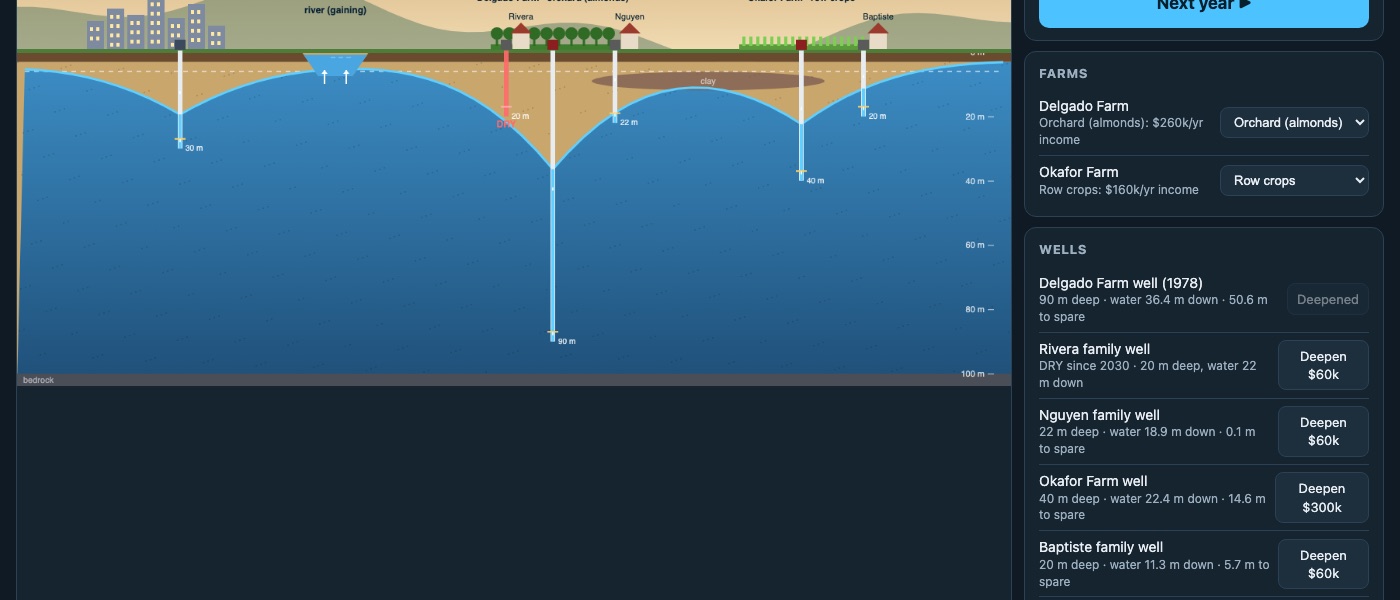
Keep a farming valley alive for 20 years without running out of groundwater. You run the valley fund. You choose the crops, deepen wells, buy imported water for the town and build recharge basins.
What it teaches: groundwater is shared. A deep well on one farm pulls the water table down under its neighbors. A recharge basin only fills in wet years, and sandy ground takes in far more water than clay.
A typical first run: a drought year hits, and deepening the farm well looks like the cheap, fast fix. Two years later, a family well next door goes dry. The town well is next. The way out costs more and takes longer: recharge basins, imported water and different crops.
Made for the Bren School of Environmental Science & Management at UC Santa Barbara, from its groundwater research. Playable prototype. Play The Aquifer
Firekeeper: a wildfire game
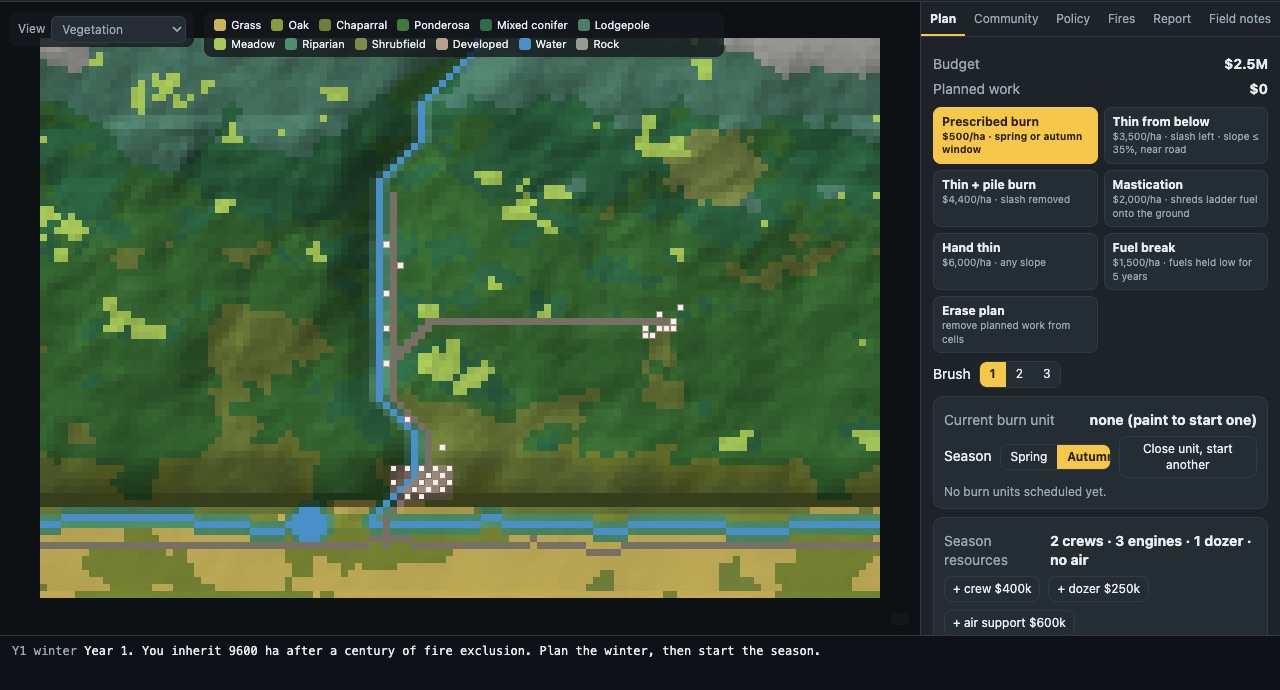
Manage 9,600 hectares of Sierra Nevada mountain forest for 40 years. A century of putting out every fire has loaded the forest with fuel. Each winter, you plan prescribed burns, thinning and home protection on a fixed budget. Each fire season, you decide which fires to fight and which fires to let burn.
What it teaches: fire is not the enemy. If you put out every fire, fuel builds up until one fire burns everything. If you burn too much, you damage habitat and fill the town with smoke.
A typical first run: you fight every fire to protect the town. For ten years the forest looks fine. Then a hot, dry, windy summer turns one lightning strike into a fire that no crew can hold. Players who win start burning on purpose, in small patches, in the cool seasons.
Fire spread, tree deaths and fuel growth follow published fire science. At the end, the game scores the forest on resilience, old growth, homes lost, smoke, carbon and the watershed, not on one number. Playable prototype, best on a computer. Play Firekeeper
Castle builder: game parts in a web page
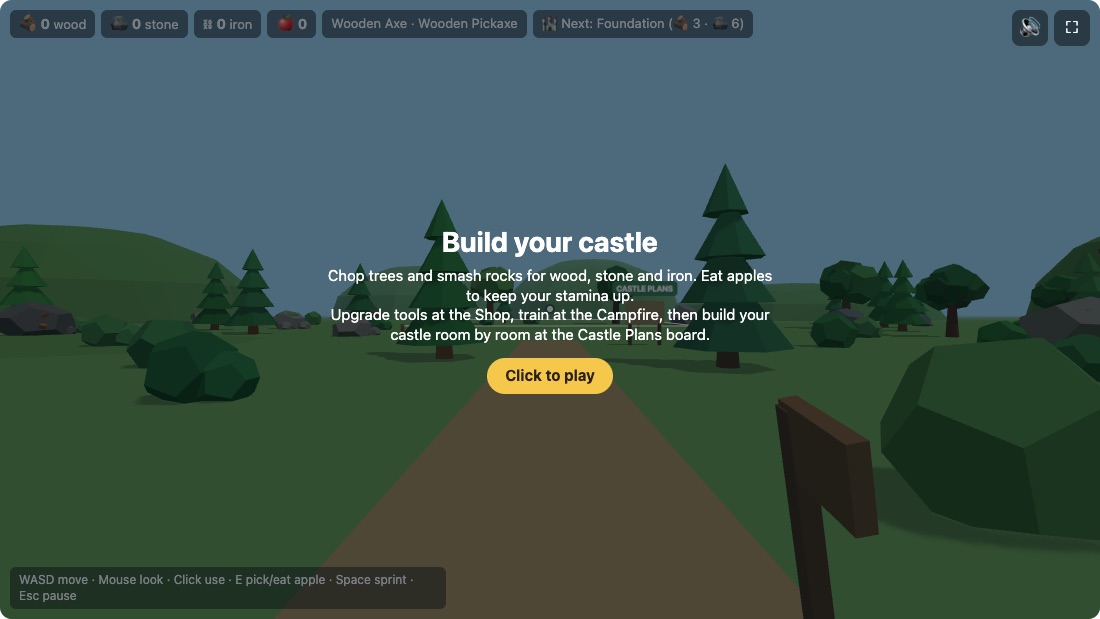
Walk a 3D valley, chop trees, break rocks and mine iron ore. Upgrade your tools at the shop, eat apples to keep your stamina up, and build a castle room by room.
The parts are simple: a meter that fills, a tool that gets better, a plan that you complete one step at a time. The same parts work in a learning app or a work tool, where a progress bar and a next step keep people coming back.
This game does not teach a subject. It tests game parts inside an ordinary Webflow page, with no download and no outside hosting. Playable on a computer with a keyboard and mouse. Play the castle builder at the top of this page
Game parts that any app can borrow
The three games share a small set of parts. Each part can make a training tool, a dashboard or a lesson feel like play:
- Resources and an inventory: wood, stone, money, water. The player sees what they have and what each action costs.
- Upgrades and unlocks: better tools, deeper wells, more fire crews.
- A time loop with a report: one year at a time, with a summary of what changed.
- Consequences that you can see: a dry well, a burned ridge, a falling water line.
- A score with more than one number: the player balances several goals instead of maximizing one.
What I want to build next
I want to build short games for groups that manage a shared resource: water districts, fire safe councils, fisheries and classrooms. The goal is a game that a class or a board can play in one sitting and then talk about. If people misunderstand a system that you manage, a small game may be the clearest way to show it.
