


How to Screenshot an Entire Web Page: Full-Page Capture in Any Browser
How to take a full-page screenshot of a whole web page in Chrome, Edge, Firefox and Safari, on iPhone and Android, without an extension. Plus a ready prompt that has Claude in Chrome capture a whole list of pages, and what to do when a capture breaks.

The short answer. To screenshot an entire web page, use the full-page capture that is already in your browser. In Edge and Firefox, press Ctrl + Shift + S and choose the full-page option. In Chrome, open Developer Tools, open the Command Menu and run Capture full size screenshot. On an iPhone, take a normal screenshot in Safari and choose Full Page. On Android, take a screenshot and tap Capture more. You do not need an extension for any of these.
People use many names for this: full-page screenshot, scrolling screenshot, long screenshot, page capture, a screen capture of the whole page. They all mean the same thing: one image of everything on the page, including the part below the bottom of your screen.
| Where you are | How to capture the whole page | What you get |
|---|---|---|
| Chrome (Mac, Windows, Linux) | Developer Tools, then Command Menu, then "Capture full size screenshot" | PNG in Downloads |
| Edge | Ctrl + Shift + S, then "Capture full page" | Image you can mark up, copy or save |
| Firefox | Ctrl + Shift + S (Cmd + Shift + S on a Mac), then "Save full page" | PNG, download or copy |
| Safari on a Mac | Web Inspector, right-click the <html> element, "Capture Screenshot" | PNG |
| iPhone and iPad | Screenshot in Safari, then "Full Page" | Long image or PDF |
| Android | Screenshot, then "Capture more" | Long image |
| A list of many pages | Give Claude in Chrome the list and the prompt below | One zip file of images |
Why take a full-page screenshot?
A normal screenshot shows one screen. A web page is usually five or ten screens tall. If you design, build or manage websites, you need the whole page in one file more often than you expect:
- To mark up a page. Drop the image into Figma, Preview, Acrobat or a slide and write your notes on it. One image with ten comments is easier to act on than ten separate screenshots.
- To get feedback or approval. A client or a colleague can review the page without logging in, and they see exactly what you saw.
- To keep a before and after. Capture every page before a redesign. When someone asks what the old site looked like, you have it.
- To keep a record. Campaign landing pages, pricing pages and legal notices change or disappear. A dated capture is your copy.
- To check the mobile layout. A full-length capture of the phone layout shows spacing and order problems that are hard to see while you scroll.
- To study other sites. Put full-page captures of several sites next to each other and compare how they are built.
Desktop browsers
Every major desktop browser can capture a whole page without an extension. Find yours below.
Chrome
Chrome has no full-page button in its main menu. The command is in Developer Tools. You do not need to know any code to use it.
- Open the page and let it load completely. If images appear as you scroll, scroll to the bottom and back to the top first.
- Open Developer Tools:
Cmd + Option + Ion a Mac,Ctrl + Shift + IorF12on Windows and Linux. - Open the Command Menu:
Cmd + Shift + Pon a Mac,Ctrl + Shift + Pon Windows and Linux. This works only while Developer Tools has focus. - Type "screenshot" and choose Capture full size screenshot.
- Chrome saves a PNG of the entire page, usually to your Downloads folder.
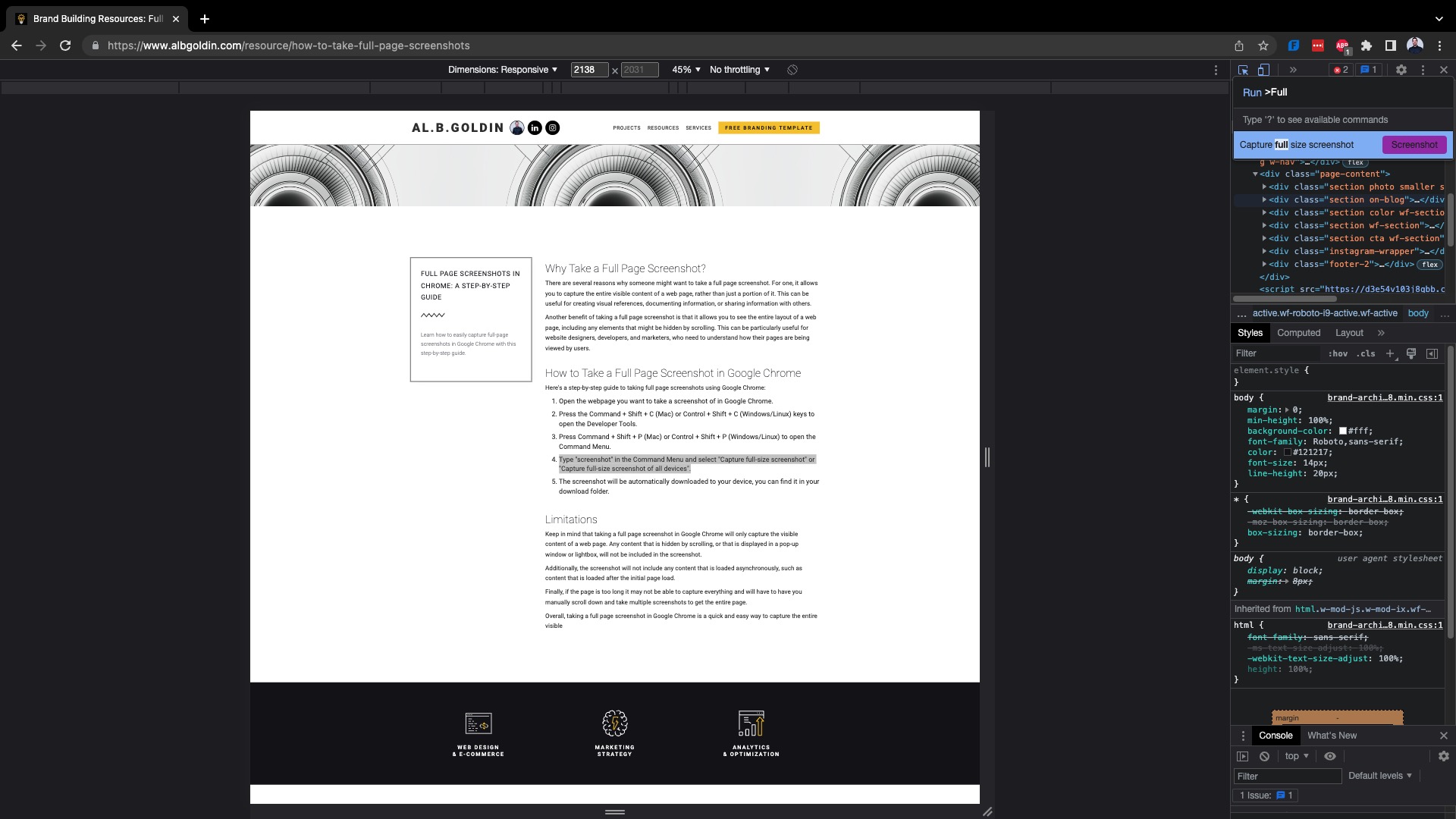
The same menu has three other useful commands. Capture screenshot saves only the visible area. Capture area screenshot lets you drag to select. Capture node screenshot saves one element that you selected in the Elements panel, which is a clean way to capture a single section or component.
Capture the mobile layout
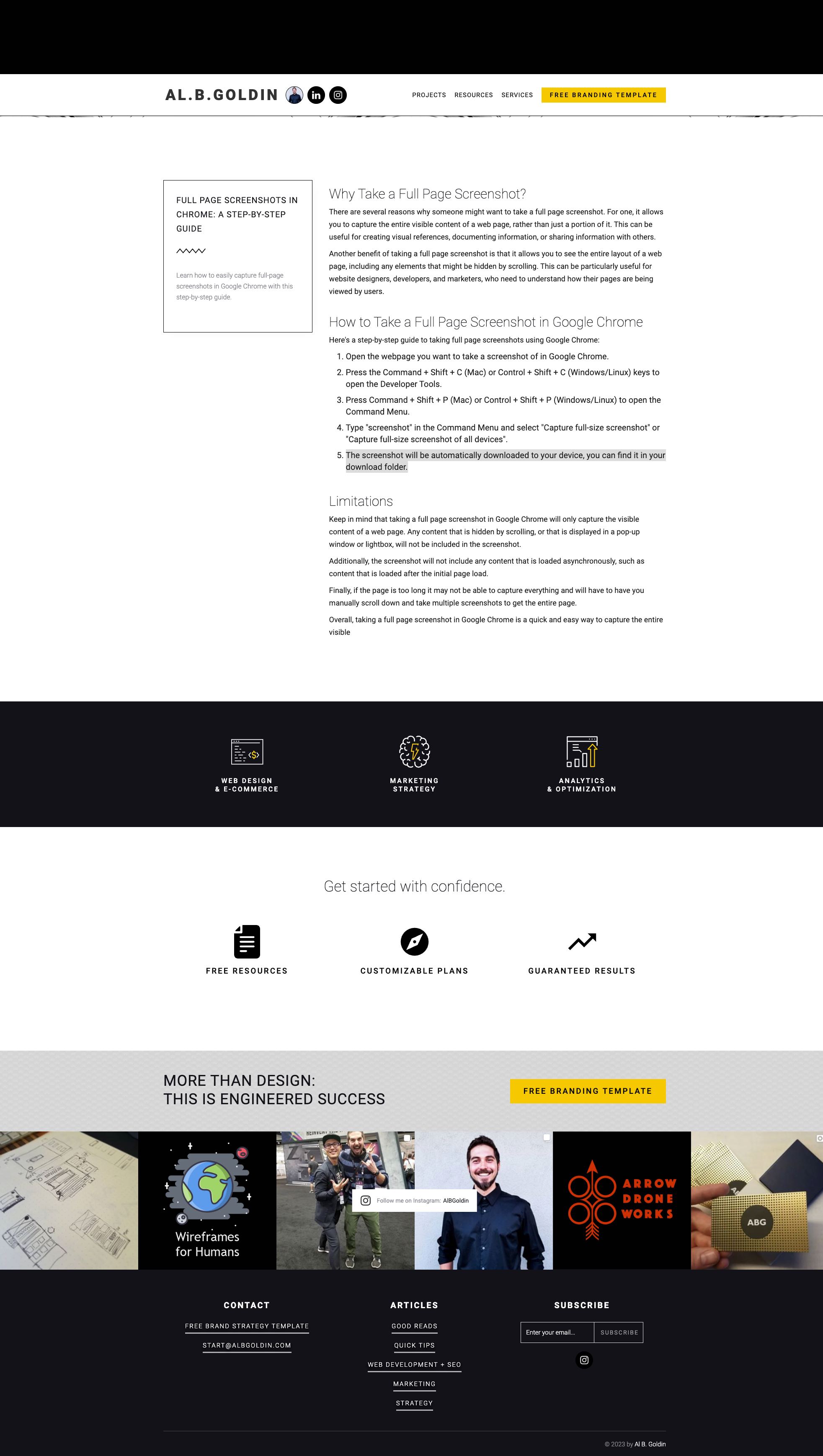
To capture how a page looks on a phone, turn on device emulation first. Click the device icon in Developer Tools or press Cmd + Shift + M (Ctrl + Shift + M on Windows and Linux). Choose a device or a width, reload the page, then run Capture full size screenshot. You get the full-length mobile layout.
Microsoft Edge
Edge has the easiest full-page capture of any desktop browser. Press Ctrl + Shift + S, or open the three-dot menu and choose Screenshot (older versions call it Web capture). Then choose Capture full page. Edge opens the image so you can draw on it, copy it or save it.
Edge is built on the same engine as Chrome, so the Developer Tools method above also works in Edge.
Firefox
Firefox has a screenshot tool built in. Press Ctrl + Shift + S (Cmd + Shift + S on a Mac), or right-click the page and choose Take Screenshot. Then choose Save full page. You can also click a single part of the page to capture only that part.
Safari on a Mac
Safari has no full-page option in its main menus, but its Web Inspector has one.
- Open Safari Settings, choose Advanced, and turn on "Show features for web developers".
- Open the Web Inspector with
Cmd + Option + I. - In the Elements tab, find the
<html>or<body>element at the top. - Right-click it and choose Capture Screenshot.
If a PDF is good enough, there is a faster way: choose File, then Export as PDF. Safari saves the page as one continuous PDF.
Phones and tablets
Your phone or tablet can capture a whole page too. Steps for iPhone, iPad and Android are below.
iPhone and iPad
- Open the page in Safari.
- Take a normal screenshot (side button and volume up on most iPhones).
- Open the screenshot. On iOS 18 and earlier, tap the small preview in the lower-left corner. On iOS 26, the screenshot opens automatically.
- Tap Full Page at the top.
- Save it. Depending on your iOS version, you can save it to Photos as an image or to Files as a PDF.
If you do not see Full Page, check that the page is open in Safari and not inside another app. Some people also report that the option disappears when Safari is locked behind Face ID or opened from a Home Screen folder.
Android
On Android 12 and later, take a screenshot (power and volume down), then tap Capture more and drag the frame down to include as much of the page as you want. Samsung phones call this scroll capture and show a double-arrow button. Some versions of Chrome for Android also have their own command: open the three-dot menu, tap Share, then Long screenshot.
Other ways to capture a page
Two other options come up often. This section shows what each one can and cannot do.
What about the Mac and Windows screenshot shortcuts?
They cannot do it. Cmd + Shift + 3 or 4 on a Mac, and Windows + Shift + S (Snipping Tool) on Windows, capture only what is on the screen. The part of a web page below the screen exists only inside the browser, so the browser has to make the capture.
Save the entire page as a PDF
If you want to print the entire page or send it as a document, press Cmd + P or Ctrl + P and choose Save as PDF. Be aware that printing uses the page's print layout. Backgrounds, menus and columns can change or disappear. When you need the page to look exactly as it does on screen, use a full-page screenshot.
Let Claude in Chrome capture a list of pages
When you need twenty pages, the manual method gets slow. For a work project, I gave Claude in Chrome a list of pages. It opened each one, captured the whole page and handed everything back as one zip file.
How it works
- Claude in Chrome is a browser extension. Claude opens tabs in your own Chrome and uses your logins, so it can capture pages behind a sign-in.
- You watch it work in a visible window.
- It needs a paid Claude plan.
- A plain screenshot shows only the visible window, so ask for the whole page in words. In my experience, Claude then scrolls and joins the parts, or runs a small script in the page.
The prompt
Open each URL in the list below, one at a time. For each page, wait until it has fully loaded. Scroll to the bottom so that lazy-loaded images and scroll animations appear, then scroll back to the top. Capture the whole page from top to bottom, not only the visible window. Name each file after the page path, for example about-us.png. When every page is done, put all the images in one zip file named site-screenshots-[date].zip and download it. Then tell me which pages failed and why.
[paste the list of URLs]
Rules and limits
- Permissions. Claude can ask before each action on a site. Before a long list, set the site to "Always allow actions on this site" in the extension's settings, or you may have to approve every step.
- Downloads. Claude asks before it downloads a file, even on an always-allowed site. Expect one approval for the zip file.
- Logins and CAPTCHAs. Claude stops and waits for you to handle them.
- Page quirks. Sticky headers can repeat in a joined image. Very tall pages may come back in parts. Scroll animations need the scroll-to-bottom step, or sections come out blank.
- Privacy. The capture shows whatever your logged-in browser shows, account details included. Check the images before you share them.
- Scale. The extension suits dozens of pages. For hundreds, a scripted browser is faster. Playwright, a free browser automation tool, does it in one line:
npx playwright screenshot --full-page https://example.com page.png. - No extension. For one page, Chrome can do it alone with the Developer Tools steps above.
A screenshot is not QA
On my own sites, I use full-page screenshots for layout checks. Each page is measured at set screen widths, from 375 to 1920 px, and the screenshots are reviewed for balance and spacing. My rule is that a screenshot is not QA. The measurements are the check, and the screenshots support them. A page can look right in one capture and still be wrong at a width you did not look at.
When full-page captures go wrong
A full-page capture renders the whole page at once, and some common design patterns do not survive that:
- Lazy-loaded images can appear blank if you have not scrolled to them yet. Scroll through the page first.
- Fixed or sticky headers can appear in an odd position or cover content. Capture sections separately with the area or node commands.
- Inner scrolling areas (content that scrolls inside a box, not the window) may be captured only at their visible height.
- Sections sized to the screen height can stretch, because the "screen" briefly becomes as tall as the page.
- Scroll animations can be captured in their starting, invisible state.
- Very long pages can exceed the largest image the browser can make, and the capture is cut off. Split the page into sections.
When a capture looks wrong, capture the problem section separately. That is almost always the fastest fix.
Questions
How do I screenshot an entire web page without scrolling? Use the browser's full-page capture: Capture full size screenshot in Chrome, Capture full page in Edge, Save full page in Firefox. The browser captures the page from top to bottom for you.
Is there a keyboard shortcut for a full-page screenshot? In Edge and Firefox, yes: Ctrl + Shift + S. Chrome has no single shortcut. Use Developer Tools and the Command Menu.
How do I screenshot a whole web page on a Mac? The Mac's own shortcuts capture only the screen. Use Chrome, Edge, Firefox or Safari as described above.
Do I need an extension? No. Extensions that capture pages usually ask for permission to read every page you visit. The built-in tools need no permission.
Can I capture a page that needs a login? Yes. The built-in tools capture what your browser shows, so log in first. Claude in Chrome also works behind a login, because it uses your own browser. Online tools that capture a page from its address cannot see pages behind a login.
Can an AI take full-page screenshots of many pages? Yes. Give Claude in Chrome a list of addresses and the prompt above. It returns one zip file and a list of the pages that failed.


© 2023 by Al B. Goldin